By Austin Williams, 33rd VA Co. H
The following article was published in the February 1, 2026 issue of the “Living History Gazette.” Read the entire issue here.
In an earlier edition of the Gazette, I provided a general overview of the various small arms cartridge patterns used by the Confederate Ordnance Department. For the living historian committed to the authenticity of his impression, correctly manufactured cartridges are only half complete if not packaged in bundles of ten as the originals were.
The practice of bundling small arms cartridges in paper-wrapped packs of ten was first adopted in French service in 1819. Due to the significant stockpile of ammunition remaining at the conclusion of the War of 1812, the U.S. Army did not resume manufacture of new cartridges until 1834. By at least 1837 this new ammunition was being put up in paper bundles, labeled to identify the caliber and arsenal of origin. Small printing presses were made at the Frankfurt Arsenal in 1857 and distributed to the principal arsenals. Once war commenced, however, Federal ordnance officials began to omit the label, relying instead on the shipping box to identify the type and origin of ammunition.1
At least some of the Confederate arsenals appear to have initially followed this wartime expedient, simply wrapping their ammunition in unlabeled paper bundles. Recounting an inspection of Charleston Arsenal, however, Confederate Superintendent of Laboratories John W. Mallet noted on 18 June 1862; “The bundles of (10) small arms cartridges, here as at Richmond, are not marked in any way. I have suggested to Capt. [Frederick] Childs [Superintendent of Charleston Arsenal], and he has promised to act upon the suggestion, that in future each bundle shall be marked with at least the caliber of the arm for which it is intended. Would it not be well, in view of the great risk, which our medley assortment of arms in the same regiment and even company entails, to introduce this same rule at Richmond?… The marking might be done very quickly by a stamp or stencil.”2
Adopting Mallet’s proposal, a 24 June circular required arsenals to label each bundle of cartridges with the “kind and caliber of ammunition, and number of rounds in the package.” Mallet’s subsequent 27 August Rules for Laboratories required; “All bundles (of 10 cartridges) and packing boxes of small arms ammunition will be legibly marked with:
- The number of rounds.
- The character of arm for which the cartridges are intended.
- The caliber.
- The character of projectile.
- The arsenal at which the ammunition has been made.
- The year of manufacture.”3
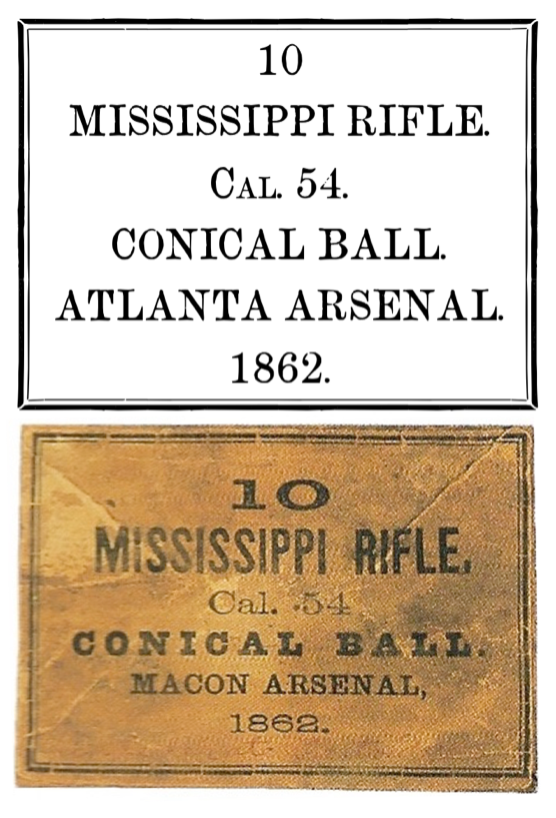
The following April, Mallet sent a notice to all arsenal commanders to reinforce this directive and enclosed an exemplar label. “Of course,” he noted, “it is not supposed that printed labels already on hand will be thrown away, but in having others printed in future it will be desirable to follow the form now sent.” That July, Mallet added the additional requirement that the month as well as the year was to be marked, but it took at least through October before Fayetteville, Macon, and Columbus were in compliance with this new rule.4
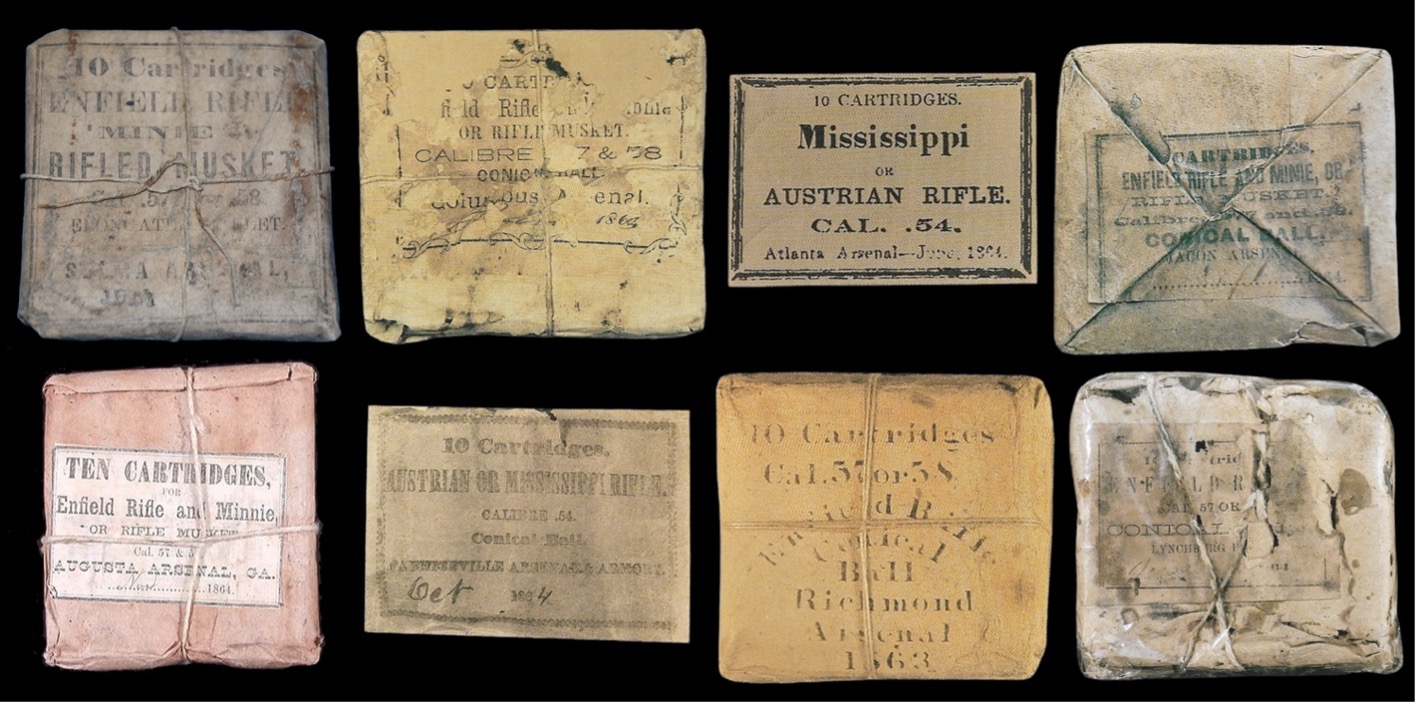
Despite Mallet’s original suggestion of a stamp or stencil, printed paper labels appear to have been more common. Richmond mostly used a stamp and failed to include the month of manufacture. Selma also printed their label directly on the bundle paper with a separate stamp to mark the month. Most arsenals that did include the month handwrote it in ink, likely so that the printed labels would not need to be changed monthly. Unsurprisingly, the only example the author could find of an extent label exactly matching Mallet’s exemplar was from Macon, the laboratory directly overseen by Mallet.
In most instances, bundles appear to have been from the same paper used to make cartridges (the medium weight paper used for old U.S. style cartridge, not the fine, thin paper preferred for English-style cartridges), although invoices of Richmond Arsenal purchases from the Franklin Paper Mill include “bundling paper” separate from “cartridge paper.” Extant arsenal packs show most of them tied with light cord, but a few have heavier twine or are tied twice if a lighter cord is used. Macon packs utilized a unique folding closure that produced four triangles on the front of the bundle, held shut with a glued label. Most surviving packs have the label underneath the cord, but there are examples of Charleston and Columbus packs with the label glued over the cord. 5
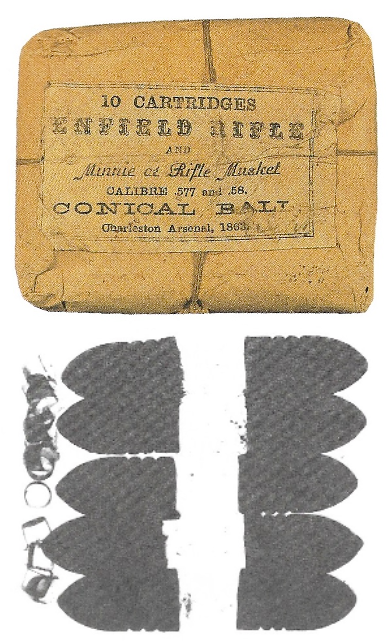
U.S. practice was to include a bundle of 12 percussion caps in each package of ten cartridges. In his post-war analysis of the Confederate Ordnance Department, Mallet recalled that at one time “the supply of nitric acid for making fulminate for caps had been exhausted, and two or three million caps had to be issued which were charged with a mixture of potassium chlorate and sulphur. These… became untrustworthy in damp air, so that an extra number was issued with each packet of cartridges until the use of fulminate could be resumed.” Despite Mallet’s recollection suggesting this was a temporary change, his own August 1862 Rules for Laboratories set the number of caps at 13. Because Richmond and Atlanta (and before it, Nashville) produced most Confederate percussion caps, arsenals were from time to time forced to issue packs without caps and were required to add “without caps” to the labels of such bundles. Imported packs of British cartridges nearly never included caps, prompting Mallet to request in August 1863 that future shipment include caps. “As the foreign caps which would be so used would probably be of good quality,” he noted, “12 caps (instead of 13) would be enough to each bundle of 10 cartridges.” At least Richmond is known to have repackaged British cartridges to add a bundle of caps.6
As with my prior article, this is only a short primer on the topic. Those seeking to learn more are directed towards Percussion Ammunition Packets: Union, Confederate & European, 1845 – 1888 by John Mallory, Dean Thomas, and Terry White and Round Ball to Rimfire Part 4: A Contribution to the History of the Confederate Ordnance Bureau by Dean Thomas.
Endnotes
- Frederick C. Gaede, “U.S. Army Accoutrement Evolution Prior to the Civil War: The ‘Fenwick’ Ordnance Board of 1837 and 1838 and the Infantry Cartridge Box,” American Society of Arms Collectors Bulletin, vol. 92 (Spring 2005), 35; John Mallory, Dean Thomas, and Terry White, Percussion Ammunition Packets: Union, Confederate & European, 1845 – 1888 (Gettysburg: Thomas Publications, 2003), 64.
- John Mallet to Josiah Gorgas, 18 Jun 1862, Superintendent of Laboratories Letters Sent, Record Group 109, National Archives, Washington, D.C.
- Dean S. Thomas, Round Ball to Rimfire Part Four: A Contribution to the History of the Confederate Ordnance Bureau(Gettysburg: Thomas Publications, 2010), 38 and 45-46.
- Mallet to G. W. Raines, 18 Apr 1863, Letters Sent; Thomas, Round Ball, 95, 108.
- Belvidere Manufacturing Co, Confederate Papers Relating to Citizens or Business Firms, Record Group 109, National Archives, Washington, D.C.
- J. W. Mallet, “Work of the Ordnance Bureau of the War Department of the Confederate States, 1861-5,” Southern Historical Society Papers, vol. 37 (Richmond: Southern Historical Society, 1909), 11-12; James C. Calhoun, Compiled Service Records of Confederate General and Staff Officers, Record Group 109, National Archives, Washington, D.C. (hereafter CSR); Mallet to Gorgas, 11 May 1863, Letters Sent; Mallet to Gorgas, 17 Aug 1863, Letters Sent; William N. Smith, CSR.